 |
 |
|
|
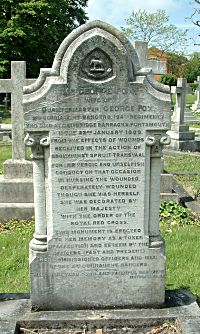
The Headstone
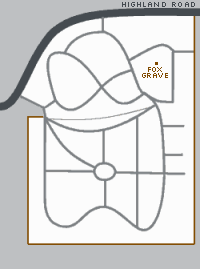
Location Plan
ARMY AND NAVY
Mrs George Fox
Gravestone Inscription
WIFE OF
QUARTERMASTER GEORGE FOX
CONNAUGHT RANGERS (94TH REGIMENT)
WHO DIED AT CAMBRIDGE BARRACKS, PORTSMOUTH
ON THE 22ND JANUARY 1888
FROM THE EFFECTS OF WOUNDS
RECEIVED IN THE ACTION OF
BRONKHUIST SPRUIT TRANSVAAL
----------
FOR HER HEROIC AND UNSELFISH
CONDUCT ON THAT OCCASION
IN NURSING THE WOUNDED
DESPERATELY WOUNDED
THOUGH SHE WAS HERSELF.
SHE WAS DECORATED BY
HER MAJESTY
WITH THE ORDER OF THE
ROYAL RED CROSS
----------
THIS MONUMENT IS ERECTED TO HER MEMORY AS A TOKEN
OF AFFECTION AND ESTEEM BY THE
OFFICERS (PAST AND PRESENT)
NON-COMMISSIONED OFFICERS AND MEN
OF THE 2ND CONNAUGHT RANGERS
Mrs Fox was the wife of Quartermaster Fox, of the Second Connaught Rangers. She accompanied her husband to the Transvaal, and while ministering to the wounded and dying on the field, at what is known as the Brunker Spruit action, was shot in the abdomen, from which the bullet was never extracted. She then for four months became a prisoner of war in the Boer camp, and there, although weak and suffering, she still continued her ministration to her fellow-prisoners. She barely escaped peritonitis, but shortly after her return to this garrison she began to suffer from partial paralysis.
When she died Colonel Bunbury issued an order in which he said:-"The commanding officer takes this opportunity of placing upon record his opinion that Mrs Fox died a soldier's death." Lieutenant-General Sir George Willis, commanding the district, followed it by an order reciting the conduct of Mrs Fox and decreeing a military funeral. 10,000 residents and strangers, and a heavy deputation of the sailors of the Navy attended this. In the procession 50 privates of the Connaught Rangers headed the line.
The pallbearers were officers. The coffin was borne on a gun-carriage drawn by six bays, caparisoned in black cloth, and each horse was mounted by an artilleryman. The carriage was covered with wreaths. Colonel Maalthus, who commanded the Rangers in the Boer war was accompanied by Quartermaster Fox as chief mourners, and he was supported by six sergeants, who had also been tended by Mrs Fox. Three military bands alternated in playing funeral marches.
Among the occupants of the scores of carriages were many ladies, of whom Mrs General Willis was one, her husband being absent on account of illness. Arriving at the cemetery gates, the Union Jack, at the corner of which hung the red cross which had been given to Mrs Fox by the Queen, was reverently spread upon the coffin, which was carried by private soldiers to the chapel where the Rev J Barton, principal Chaplain of the forces, conducted the usual service. Three volleys were fired over the grave-for the first time in military annals, it is said, over a woman, with altercations of funeral salutes from the band. The immense concierge then returned to Portsmouth, and each mourner on the way had some kind tributed to the memory of the dead heroine.
[Newspaper item from the Hawkes Bay Herald, 24th March 1888]
Further Information
ROYAL RED CROSS
.... it should be borne in mind that the South African War of 1880-1881 provides a most interesting example of the retrospective grant of an award instituted two years later. This award was the Royal Red Cross Decoration, instituted by Queen Victoria on 27 April 1883, solely for women who had shown special devotion and competency in their nursing duties with the Army in the field, or in Naval and Military Hospitals and hospital. (It may also be awarded for services with the Red Cross or kindred societies and nursing generally). Indeed, this Decoration would appear to be the only one for which women alone were eligible, and the South African War of Independence provided its earliest recipients.
Four ladies received the award: Mrs Fox, Mrs Smith, Mrs Maistre (for their services at Bronkhorstspruit) and Mrs Gildea, the wife of Lt Col Gildea (for her services at Pretoria). The awards were authorized in 1884 for Mrs Fox, Mrs Maistre and Mrs Gildea (these being the earliest recipients of the Decoration, apart from members of the Royal Family) and in 1905 for Mrs Smith (who subsequently became Mrs Jeffreys). The late award of Mrs Smith's Decoration was, perhaps, compensated for by her award of the Silver Medal for deeds of gallantry of the Order of St John of Jerusalem, upon her return to England.
[Extract from http://samilitaryhistory.org/vol055sm.html]
The 1871 Census shows Colour Sergeant George Fox with his wife Ann in barracks at Aldershot.
For information on the Connaught Rangers see Wikipedia.